I’ve worked from home since around 2016 or 2017. My office workspace is in the finished basement, not far from the furnace room. And when I say not far, I mean roughly six feet away.
That presented a problem.
Furnaces make noise. Water heaters do as well. Fans run, motors start, and air moves through ductwork. None of it is particularly unusual, but when you’re sitting nearby trying to work all day, you start noticing it.
So I decided to do something about it.
What I didn’t realize at the time was that this would turn into a nearly decade-long effort to quiet down various parts of my house, my servers, and just about anything else that decided to make noise.
And every time I succeeded, I discovered something else I could hear.
In This Article
- It Started With the Furnace Room
- Then COVID Happened
- I Could No Longer Hear the Mailman
- Of Course, I Also Have Servers
- Some Equipment Simply Had to Go
- Then the Refrigerators Got Annoying
- The Sump Room Became Another Project
- The Servers Weren’t the Only Things Vibrating
- Apparently, I Started Something
- What I’ve Learned After Nearly Ten Years
- Materials and Products I’ve Used
Affiliate disclosure: As an Amazon Associate I earn from qualifying purchases. Some links in this article are affiliate links, which may earn me a small commission at no additional cost to you.
It Started With the Furnace Room
The first substantial project was adding Rockwool mineral wool insulation to the walls of my basement furnace room. I’d done some research into the “best” soundproofing materials, only to discover that there were plenty of opinions about what “best” actually meant. Of the materials available locally, Rockwool seemed like the most promising place to start. I figured anything that made the furnace a little less noticeable during the workday would be an improvement.
The difference was substantial.
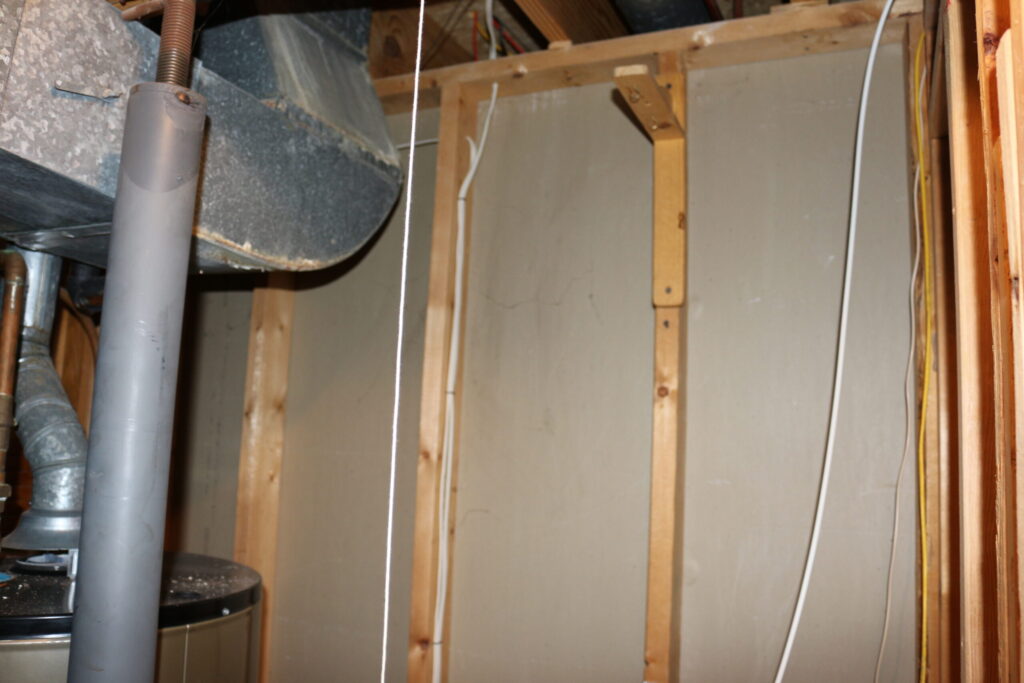
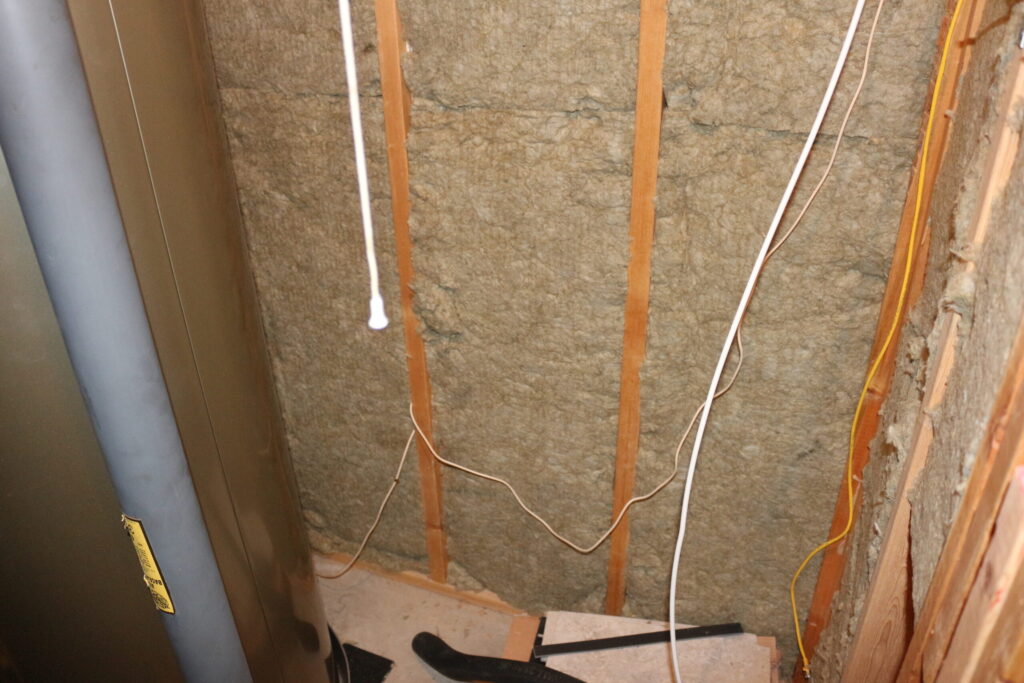
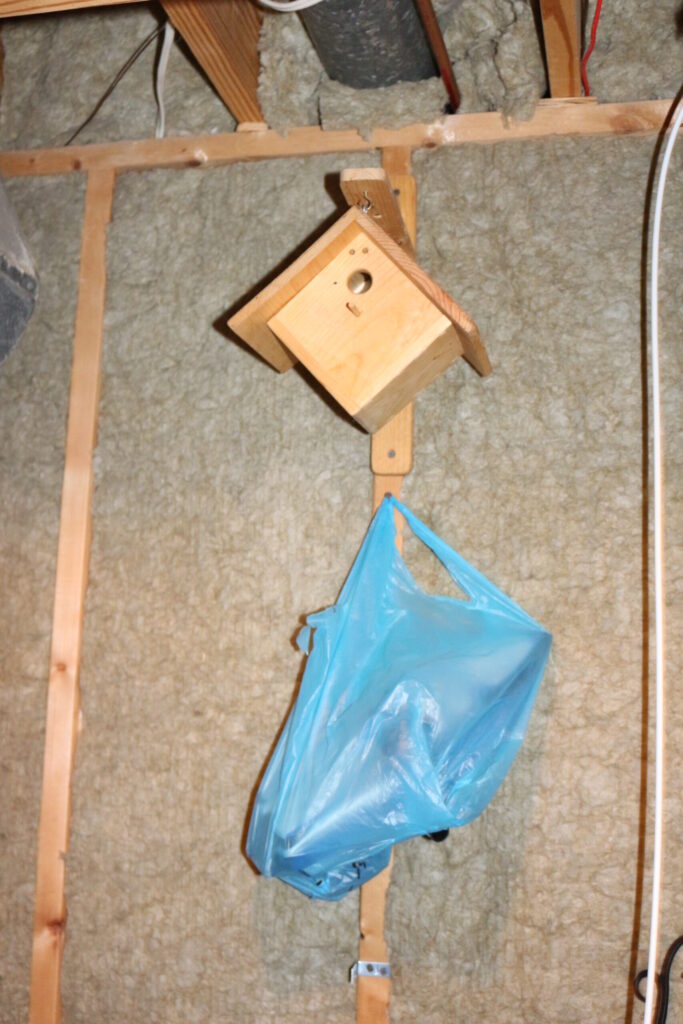
The furnace didn’t stop making noise, of course. But much less of that noise made it through to my workspace. I was genuinely astonished at how much quieter the furnace sounded while running, and the normal signs of life from the water heater just went away. I will add that the furnace room has two bi-fold louvered doors on one side (and a single bi-fold on the opposing side) so we were never going to get complete silence. But it was my first real experience with Rockwool as a sound-deadening material, and it certainly wouldn’t be my last.
Then COVID Happened
When COVID arrived, the kids were home a lot more. My son had his computer on the main floor, directly above part of my basement workspace. On hardwood floors.
And he had a mechanical keyboard. A clicky mechanical keyboard. I could hear every keypress. Every conversation. Everything.
After a short while, I decided to see whether Rockwool could help with that problem, too.
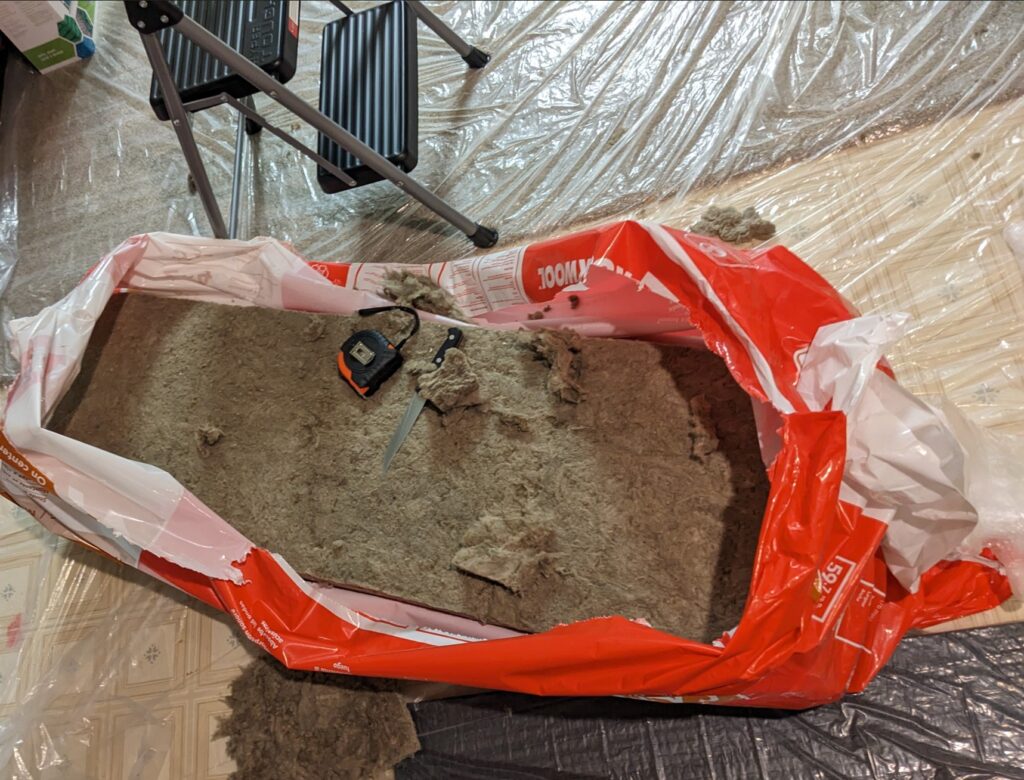
Fortunately, my basement has a suspended ceiling, so I could remove the ceiling tiles and install Rockwool between the floor joists above them. I started beneath his computer area. It was messy work, but proper attire helped: long sleeves, long pants, gloves, safety glasses, and a mask, which I already had plenty of lying around. I also covered the floor with inexpensive plastic sheeting, which made cleanup considerably easier.
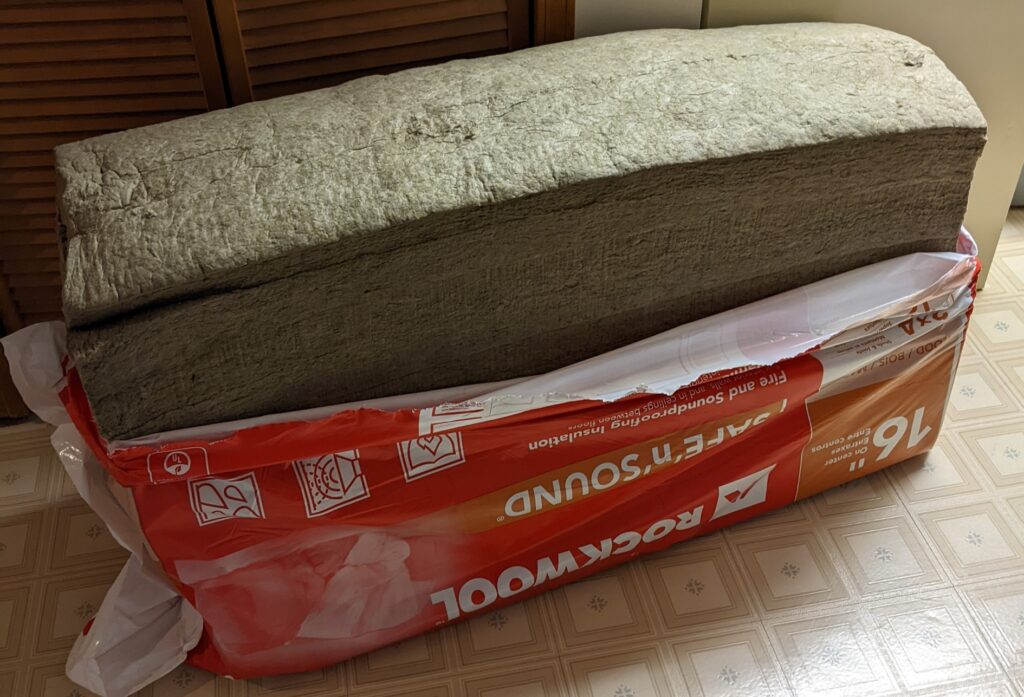
That test helped enough that I began expanding the treatment into other parts of the basement.
One thing I discovered was that the insulation alone wasn’t the entire answer. There were large openings in the floor around some of the furnace ductwork. Those gaps provided easy paths for sound to travel between floors. I used spray foam to seal the larger openings, then fitted Rockwool into the surrounding spaces.
That combination made a noticeable difference.
Eventually, I installed Rockwool above much of the basement ceiling, including the sump room.
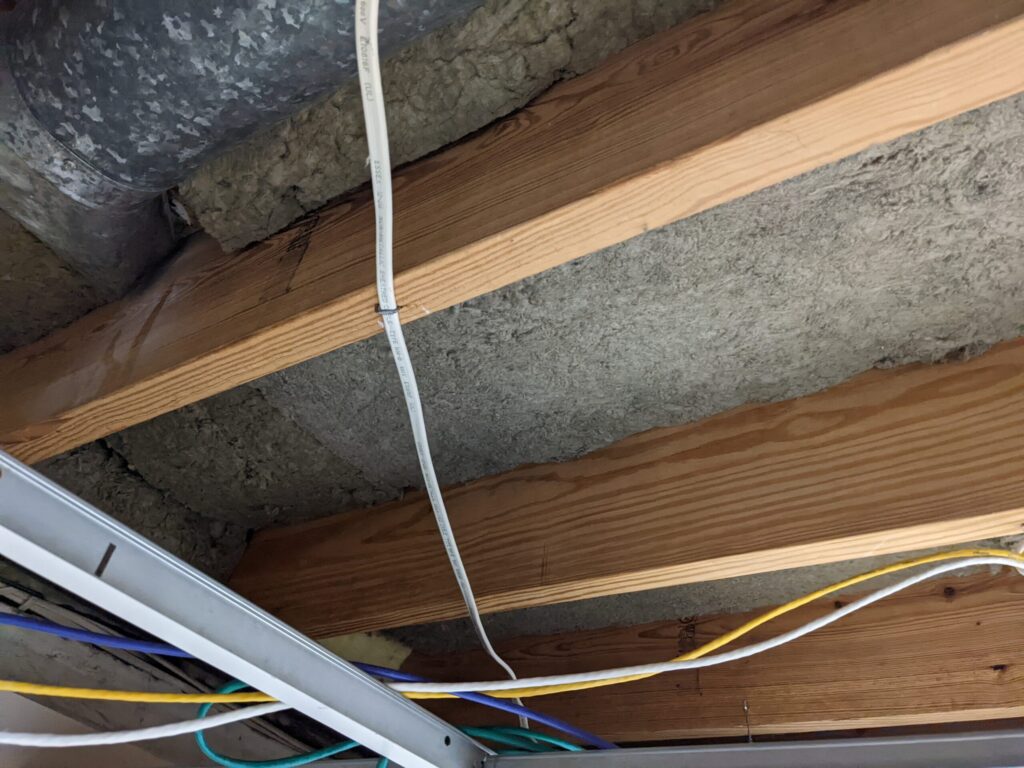
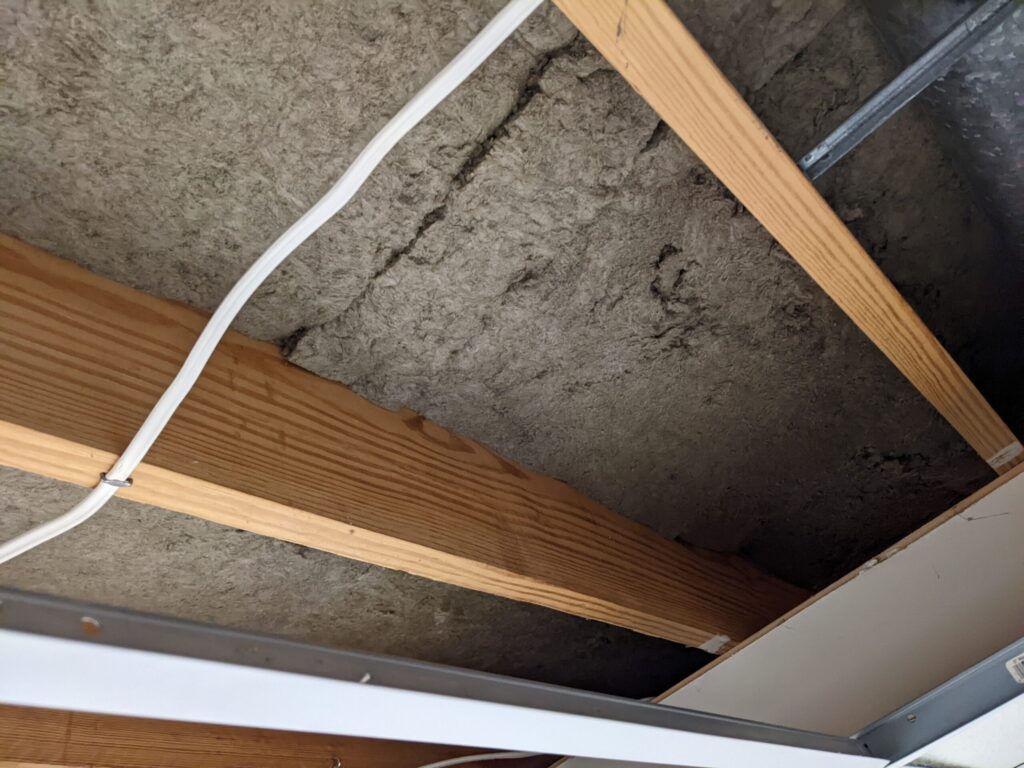
It also greatly reduced the sounds I could hear from upstairs, including activity in the bathroom near the front hall. Footsteps were muted, and normal conversation from the room above could not be heard anymore unless the basement door was open.
And then I discovered something I hadn’t expected.
I Could No Longer Hear the Mailman
While working around the basement perimeter, I started putting sections of Rockwool into the rim-joist cavities.
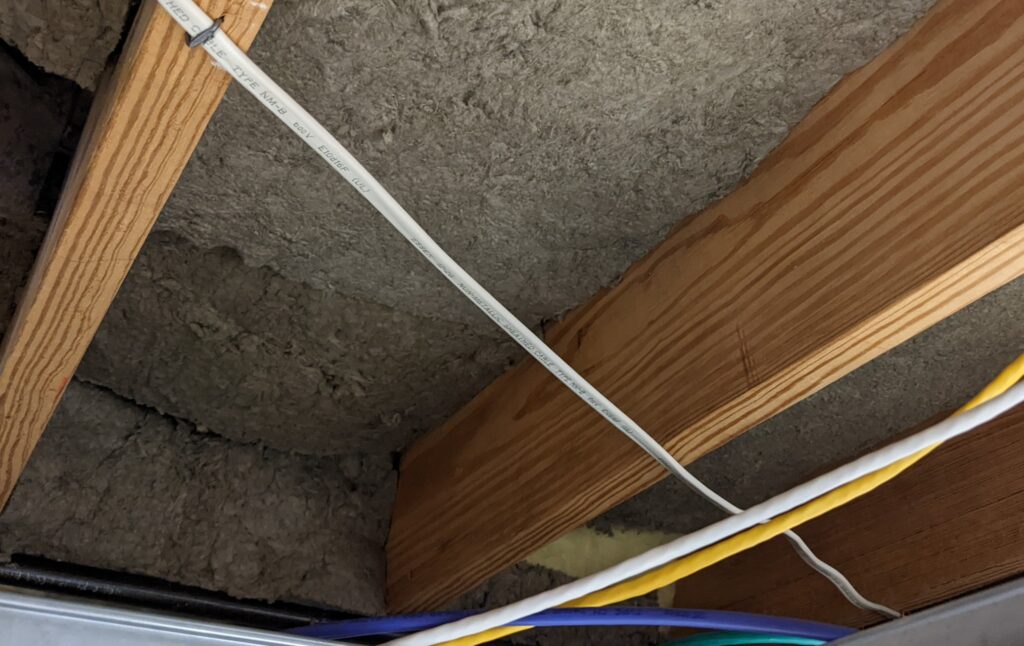
I wasn’t expecting anything particularly dramatic. But suddenly I couldn’t hear the mail carrier arriving across the street. Or the school bus. Those were sounds that had always been audible in my basement, and now they were dramatically muffled. It took me a while to realize those sounds were missing. I’d become so accustomed to hearing them while working that I hadn’t really thought about how much outside noise was getting into the basement.
That was one of the more surprising results of the entire project.
It also reinforced something I’d been learning: sound finds its way through all sorts of openings and cavities. Sometimes treating a place you hadn’t given much thought to makes an unexpectedly large difference.
Of Course, I Also Have Servers
My basement isn’t just a workspace. It’s also where I keep quite a bit of computing equipment.
Including Dell PowerEdge servers.
Anyone who’s spent time around rack servers knows that noise is part of the package. Some are tolerable in a home environment. Others sound like they’re preparing for takeoff.
The single biggest improvement I made to my servers at the start was reducing fan speeds through IPMI. (If you want to read how I accomplished that, check out my Why I’m Still Running Dell PowerEdge R720s in 2026 article.)
That addressed the noise at its source, which is generally preferable to trying to absorb it afterward. Naturally, you need to keep an eye on component temperatures and ensure the equipment is still getting adequate cooling. But even after reducing the fan noise, there was still vibration and sound traveling through the equipment and whatever it was sitting on.
So I started experimenting with mass and isolation.
MDF boards. Pieces cut from heavy rugs. Felt feet. Different combinations of those materials between equipment, shelves, and supporting surfaces.
I’ve purchased quite a few rugs over the years (these are my favorites by a wide margin), and portions of them have ended up in places that probably weren’t envisioned by the manufacturer.
Over time, I discovered that no single material worked particularly well for everything. What made the biggest difference was usually some combination of materials, often arranged in ways I hadn’t originally planned.
MDF boards could add mass, whether placed beneath a server, on top of it, or even standing on edge alongside it. Rubber or felt feet could help reduce vibration passing from one surface to another. Pieces of heavy rug and acoustic mat could help damp vibrations and absorb some of the sound bouncing around the equipment.
I found that combining these materials generally worked better than using any one of them alone. What helped with one piece of equipment didn’t necessarily make much difference with another. Sometimes I’d try something, listen for a while, and then move things around or add another layer to see if it helped.
There wasn’t much science involved in my testing. Mostly trial and error, and a lot of listening.
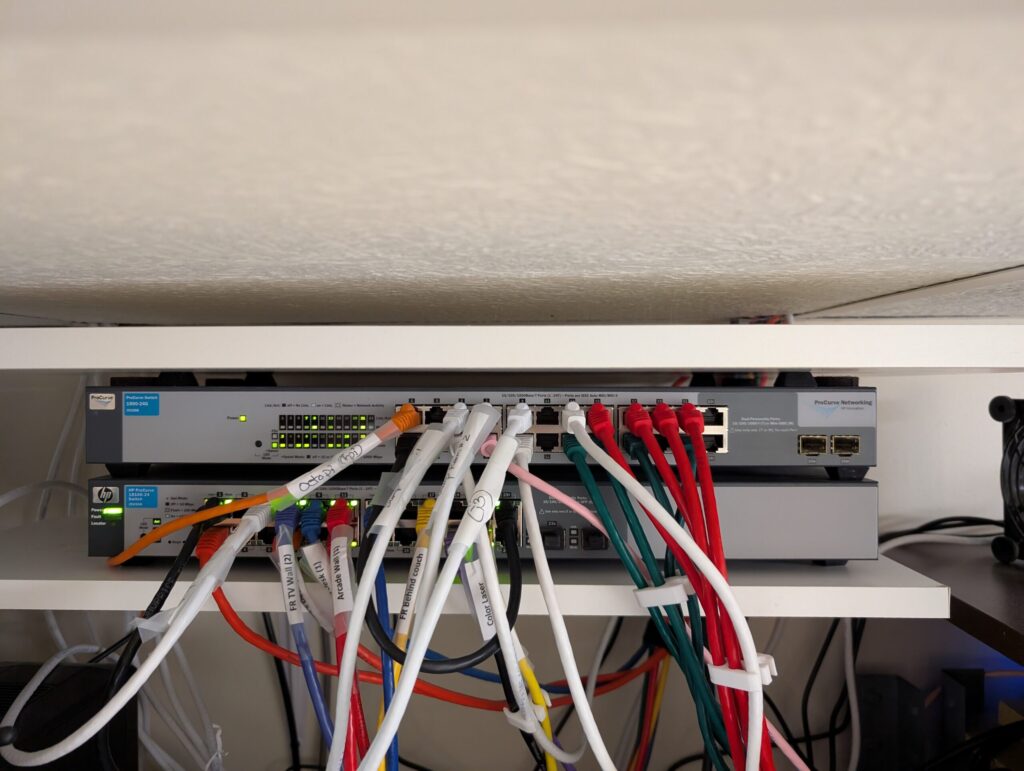
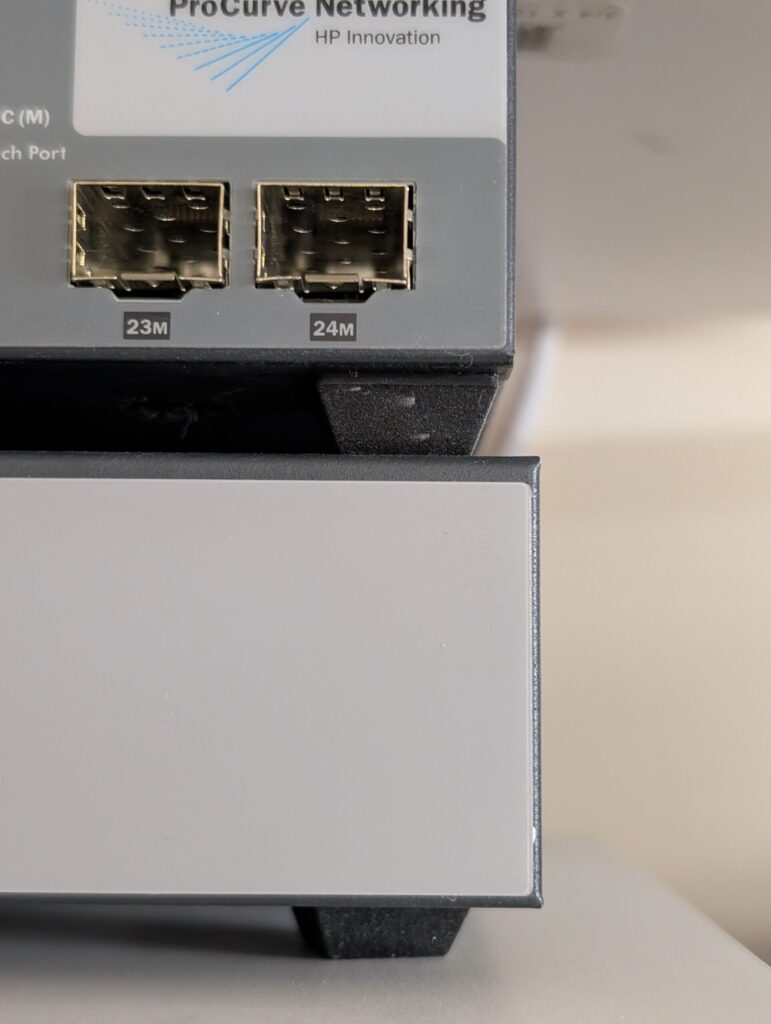
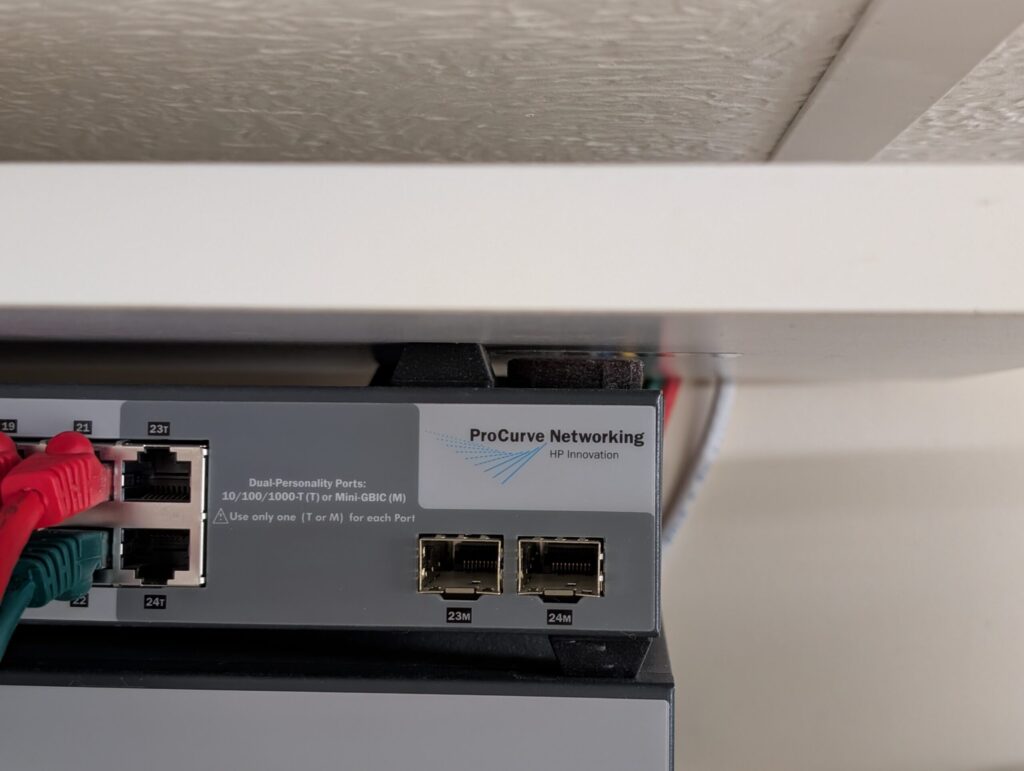
I used a similar approach with my network switches. Rubber feet underneath the switches helped separate them from the surfaces they were sitting on, while additional rubber feet and felt pads provided clearance between the upper switch and the shelf above it. I also positioned a fan to the right of the switches to blow fresh air toward them. As with the servers, I was trying to accomplish two things at once: reduce the transmission of vibration and make sure the equipment had enough airflow to stay cool.
One R720, Quite a Few Layers
One of my Dell R720 arrangements illustrates just how far I took this.
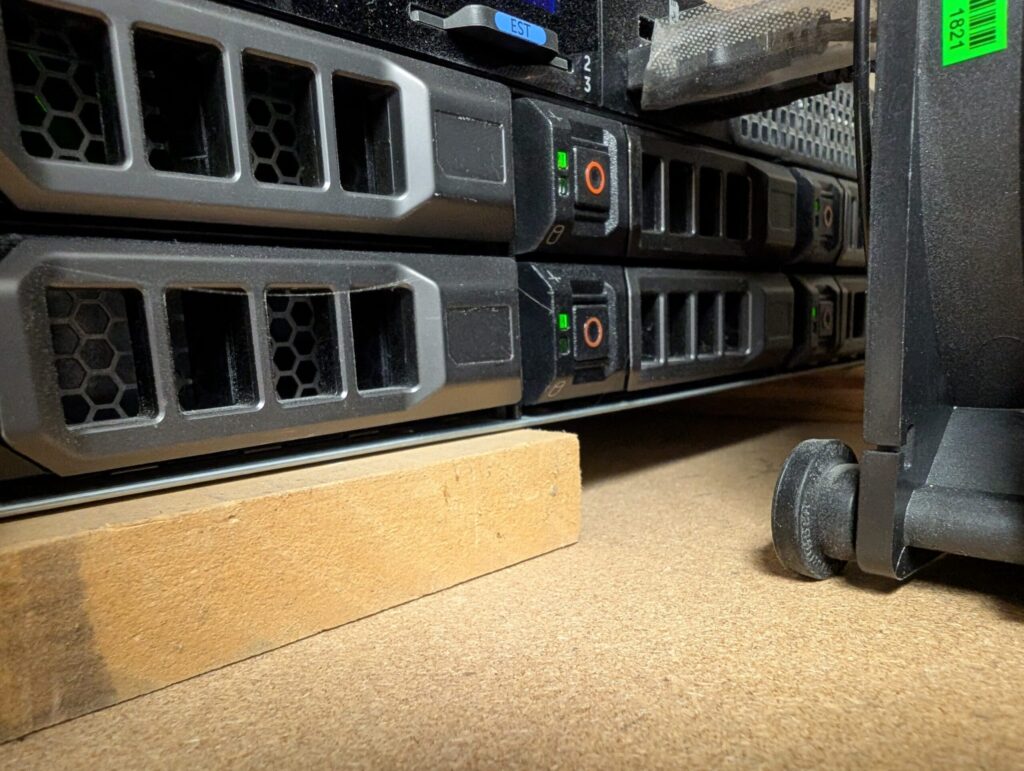
The server sits on a plywood shelf, but originally I had it resting directly on that surface. That turned out to be a mistake. The underside of the shelf was getting so hot it felt like it was cooking.
I eventually added two MDF ledger boards beneath the server, raising its middle section about 3/4 of an inch above the shelf. I also positioned a 150mm fan at the front, blowing fresh air toward the server. Those two changes made a substantial difference in how hot the shelf underneath became.
Apparently, giving the heat somewhere to go is important. Who knew?
With that problem addressed, I could get back to making things quieter.
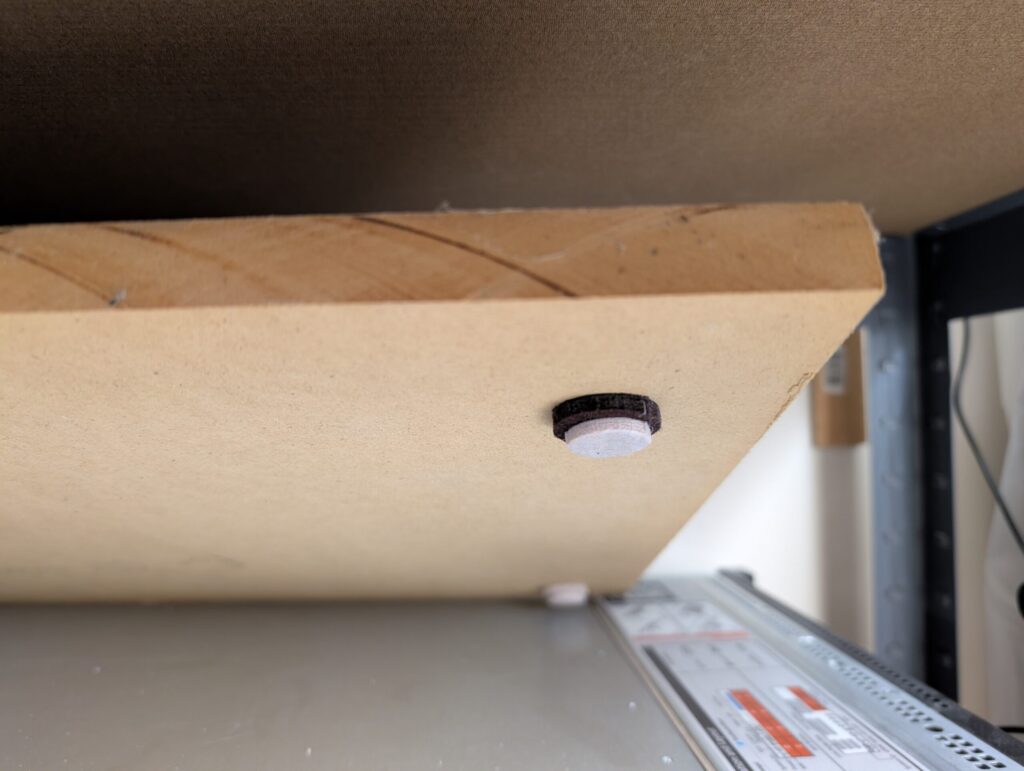
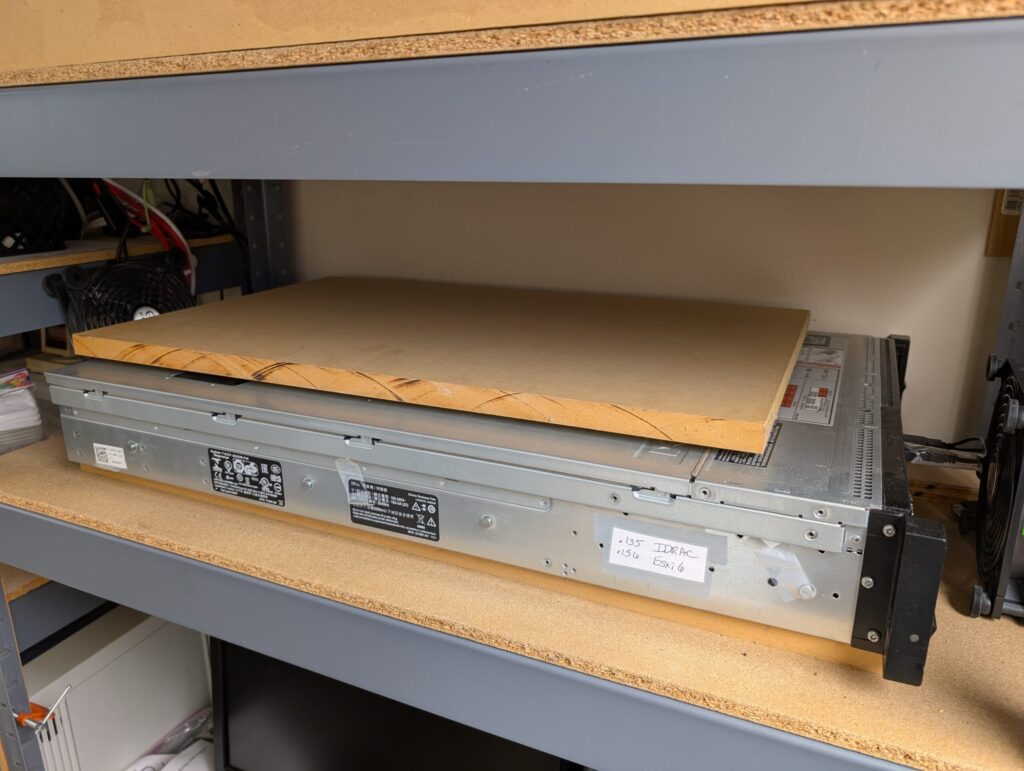
Above the server, I placed another MDF board to add mass, using felt spacers to separate it from the server. The spacers also provided a small gap for airflow, while keeping the board from sitting directly against the server’s case.
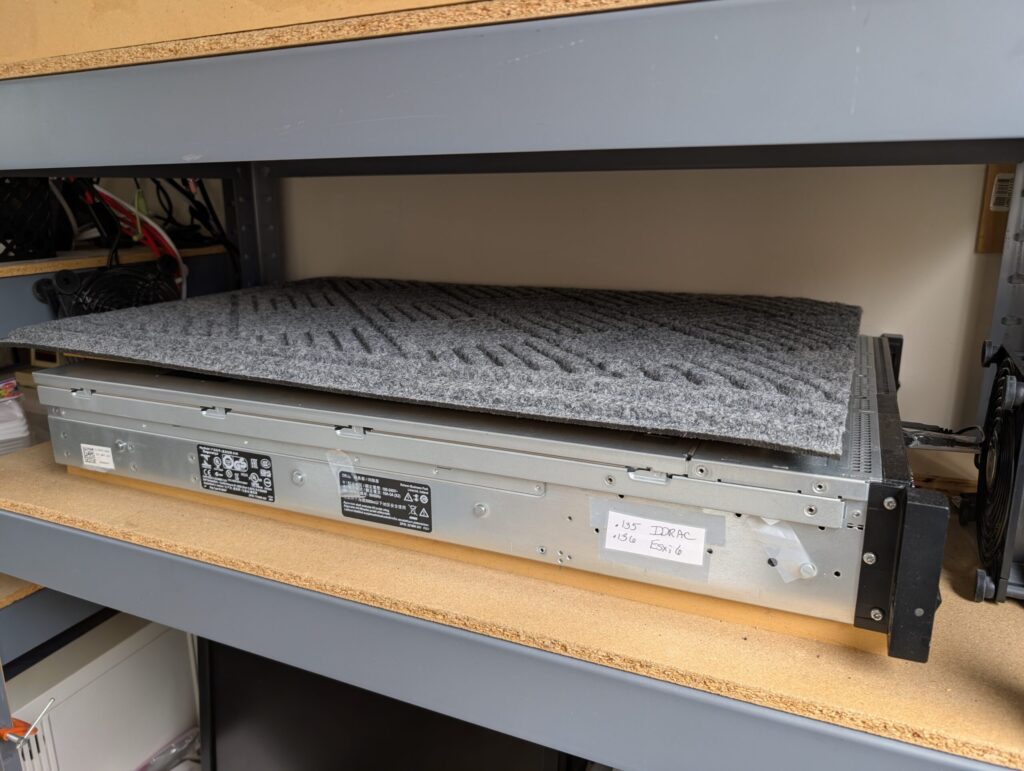
I then added a section of heavy rug on top of the MDF, making sure it wasn’t long enough to hang over the ventilation openings near the front of the server.
If you want to increase a server’s temperature real fast, be sure to block them.
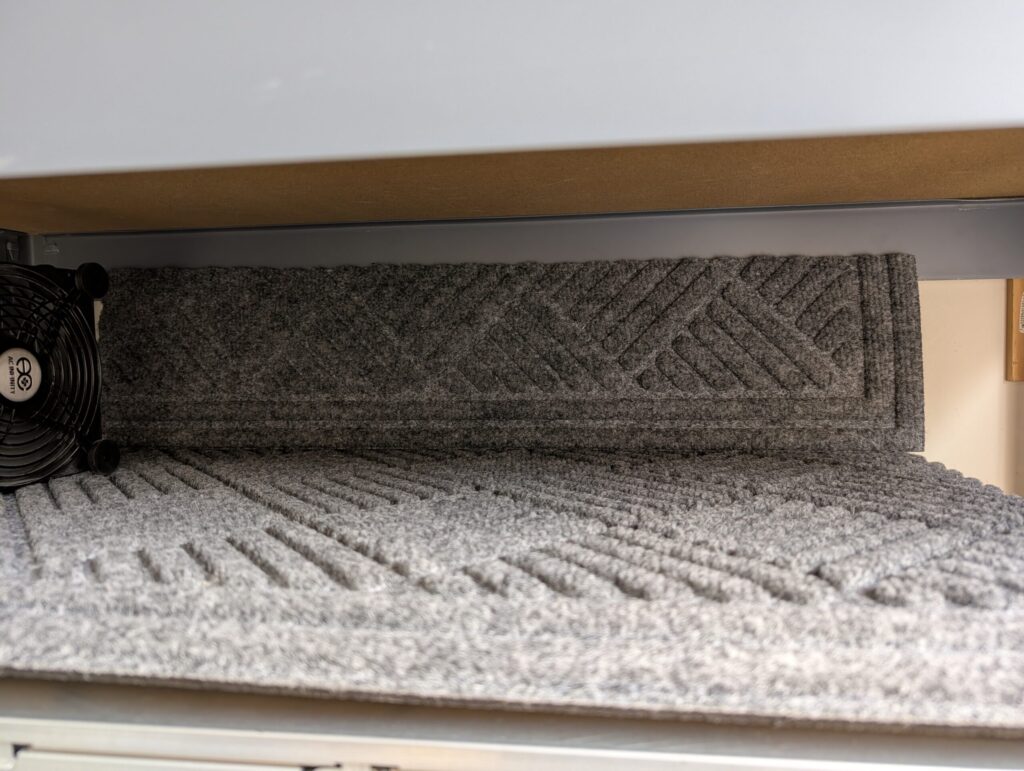
I also put a piece of rug vertically against the wall behind the server, hoping to reduce some of the sound reflecting off that surface and traveling upward. It seemed to make a slight difference. A 120mm fan in that area helps keep air moving out the back and into the rest of the basement space.
Apparently that still wasn’t enough experimenting.
I added felt acoustic panels along the side of the server, filling much of the open space between the equipment and the shelving. The idea was to absorb some of the sound that would otherwise exit from the side of the server and go directly into the main space. I’d discovered these panels while looking for other ways to reduce equipment noise.
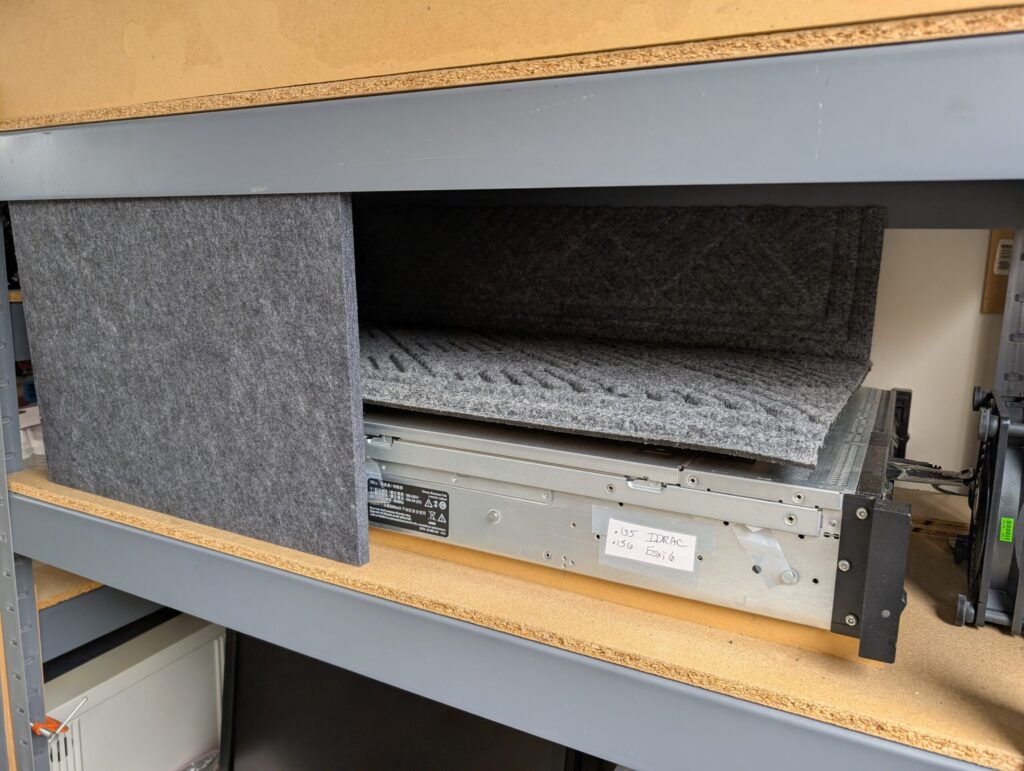
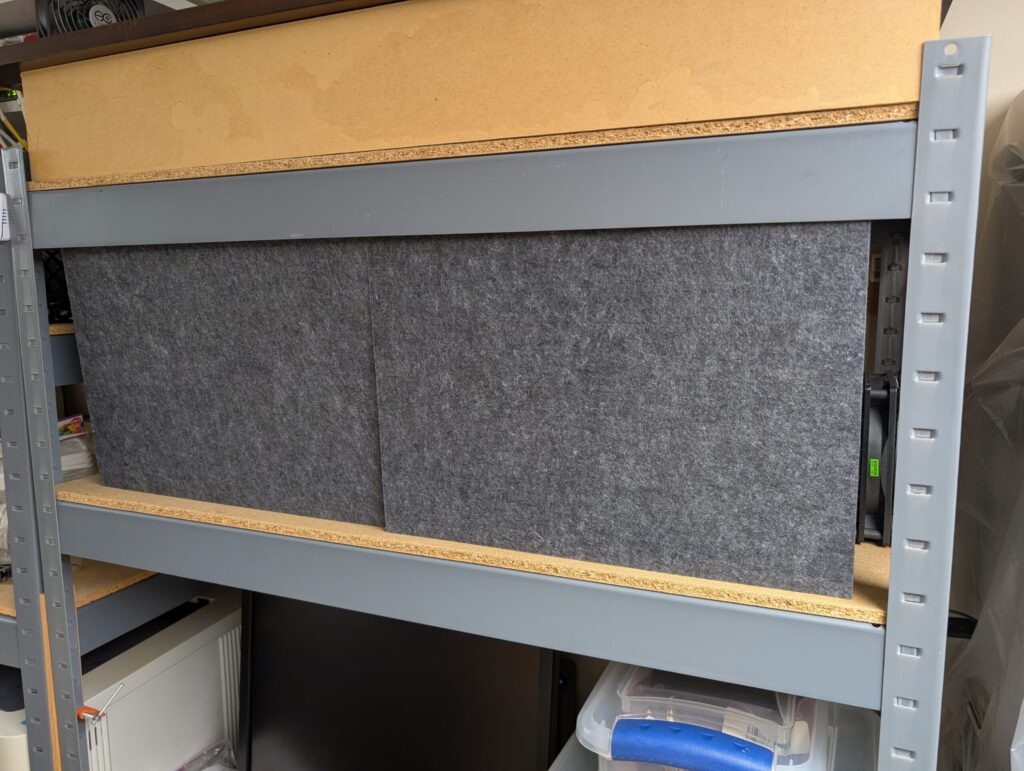
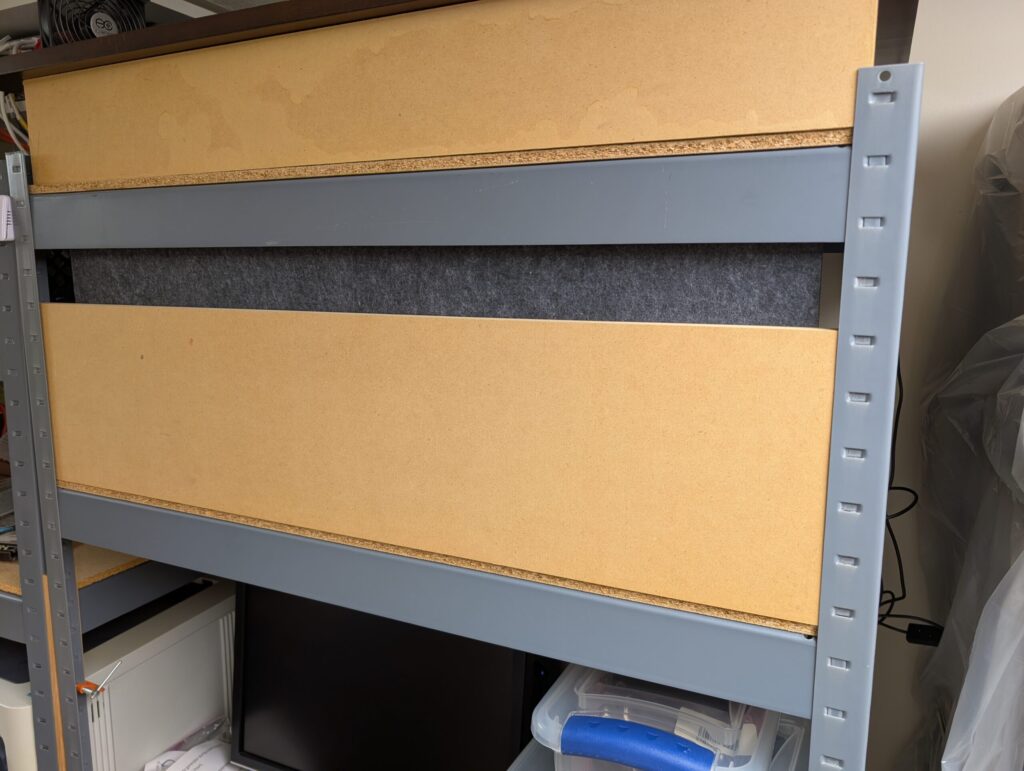
By the time I finished, I had MDF, felt, rug sections, and acoustic panels surrounding various parts of the server. It looks a little unusual, but each addition was something I tried for a reason.
Importantly, I wasn’t trying to seal the server inside a box. The intake and exhaust areas still needed to remain clear, and I continued monitoring temperatures to make sure the arrangement wasn’t creating another problem. During the tweaking phase, keeping heat in check was even more important than the sound reduction.
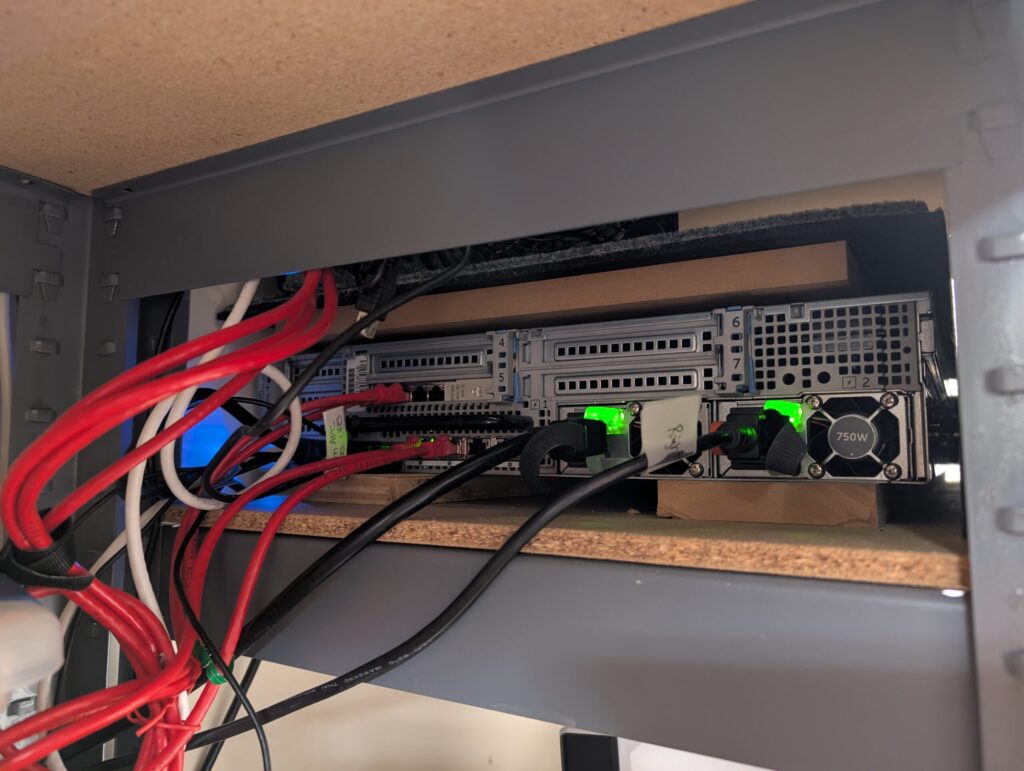
Did all of this help?
I believe so.
I can’t tell you exactly how many decibels any of these arrangements eliminated. I was just experimenting with different materials, listening to the results, and making adjustments. Sometimes I’d add something, decide it helped, and then find another place where I thought a similar treatment might be useful.
But here’s something that tells me all that experimenting was worthwhile. When people come down to the basement for the first time, they generally have no idea there are two enterprise servers running on a storage rack nearby. I usually have to tell them, and sometimes even show them where the servers are. I’d call that a success.
My Dodeca computer, for example, also ended up with sections of rug and felt acoustic panels around it. Apparently, once you start cutting up rugs for sound reduction, it’s difficult to stop.
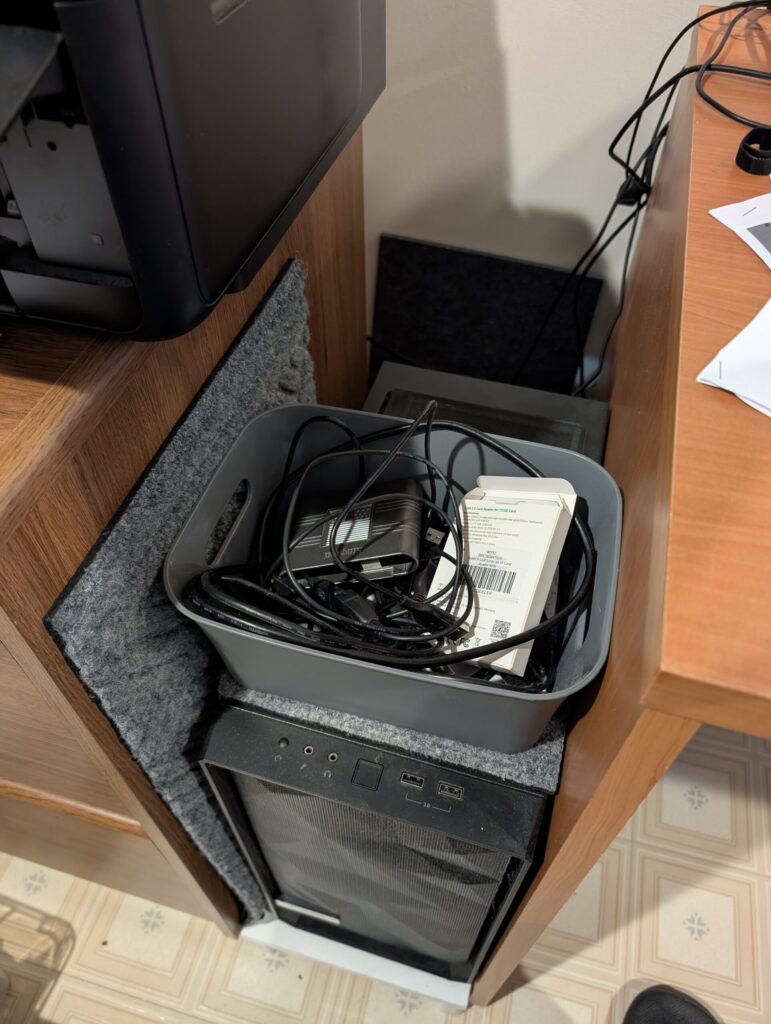
None of these additions individually produced the kind of improvement I got from slowing the server fans through IPMI. But together, they helped make the remaining noise less noticeable.
And in a basement where I spend my working day, even small improvements are welcome.
Some Equipment Simply Had to Go
There was one kind of server noise I never managed to tolerate: the pitch of the fans in 1U equipment. Even when the fans weren’t running particularly fast, that high-pitched sound drove me nuts.
It wasn’t necessarily the volume that bothered me. A steady, lower-pitched fan sound I could live with. That high-pitched whine was another matter.
Dell R420s were among the machines that convinced me 1U servers weren’t going to be part of my home lab. Early on, several got decommissioned and ended up at my house. Even after reducing their fan speeds through IPMI, I could still hear that annoying whine.
The same went for fan-equipped network switches, including some castoff Cisco 24-port and 48-port PoE switches. Once I discovered I couldn’t adjust their fan speeds, regardless of the load, they went into the pile of equipment destined for other homes.
I could experiment with vibration isolation and sound absorption all day, but neither was going to make me tolerate that particular pitch. So the equipment went to other households. Apparently, their occupants were more tolerant than I was. Nobody complained, anyway.
Although one buddy who received a PoE switch from me ended up installing Rockwool in his server room ceiling because his wife could hear the switch in the room above. Once the Rockwool was installed, the problem was resolved.
And he got a free PoE switch to power all his PoE security cameras.
Sometimes the most effective sound treatment is getting rid of the silly thing making the noise.
Then the Refrigerators Got Annoying
Here’s the funny thing about making a room quieter: You don’t necessarily end up with silence.
Instead, you start hearing things that were previously masked by louder noises. Once I’d reduced the furnace and server noise, and much of the sound transfer from the floor above, other equipment became more noticeable.
I have two smallish refrigerators and a small chest freezer in the basement. Whenever their compressors started, the noise seemed to travel along the concrete floor and reflect off the drywall behind them.
I tried placing sections of my favorite rug beneath each appliance, and that helped. But I kept looking for other ways to reduce the noise.
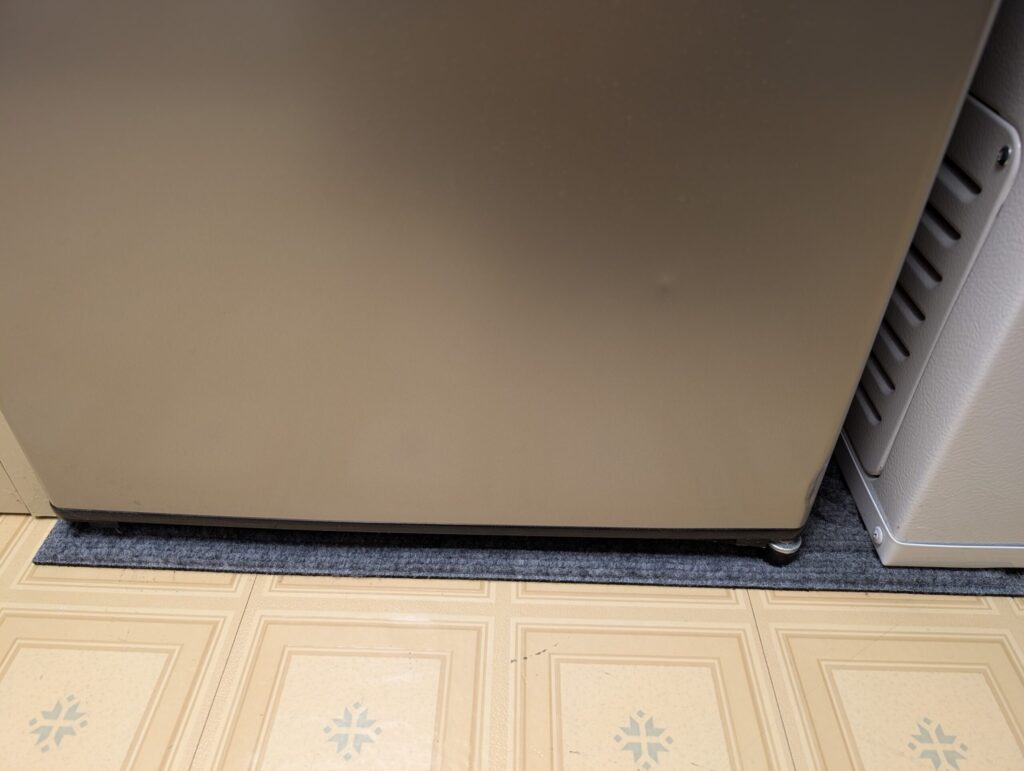
I also attached a couple of acoustic panels to the wall immediately behind each compressor area. These were the same type of panels I’d experimented with around my servers, and I figured they might help with some of the sound reflecting off the drywall.
That helped further.
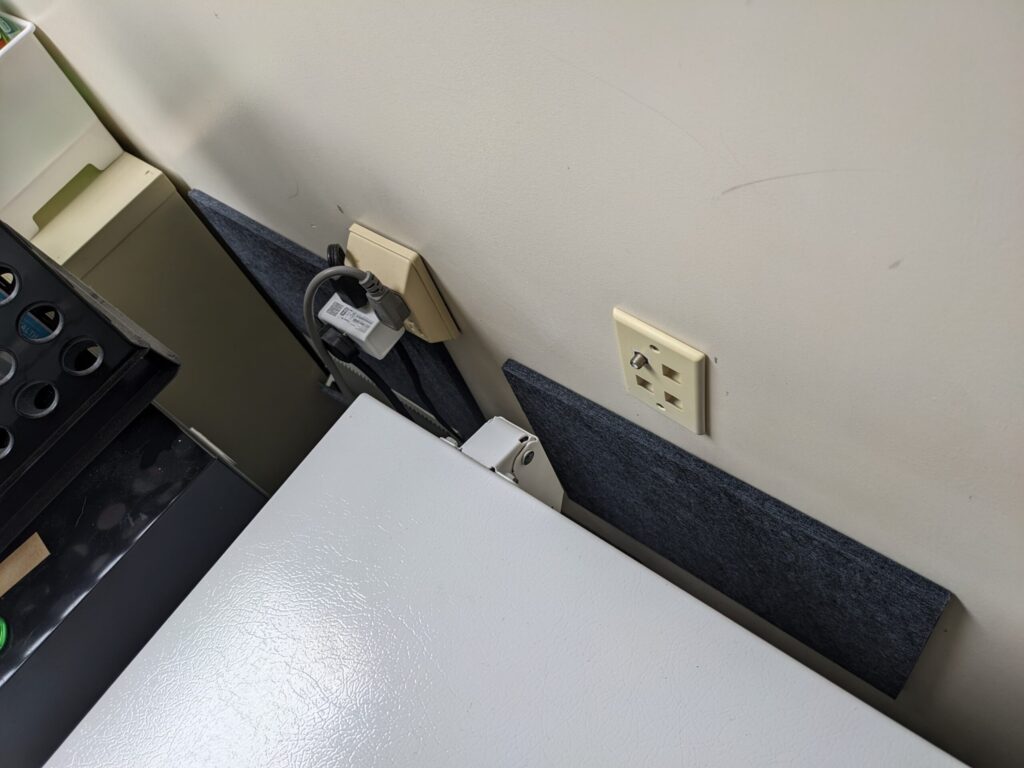
The rug sections and wall panels were doing different jobs. The material beneath the appliances helped with overall vibration, while the wall panels helped absorb some of the sound in that area. Again, it was the combination that gave me the results I wanted.
I subsequently found other places to use the panels, including around equipment in the sump room.
And eventually, even behind my 3D printer.
My Ender 3 printer sits in front of a large, otherwise bare wall. I’d already upgraded it with a Creality silent motherboard, which made the stepper motors substantially quieter than they were originally. That took care of much of the printer’s noise, but there was still some vibration and other noise to deal with.
I placed acoustic panels on the wall behind the printer and a mat beneath the printer itself. The mat definitely reduced the amount of vibration being transferred to the supporting table.
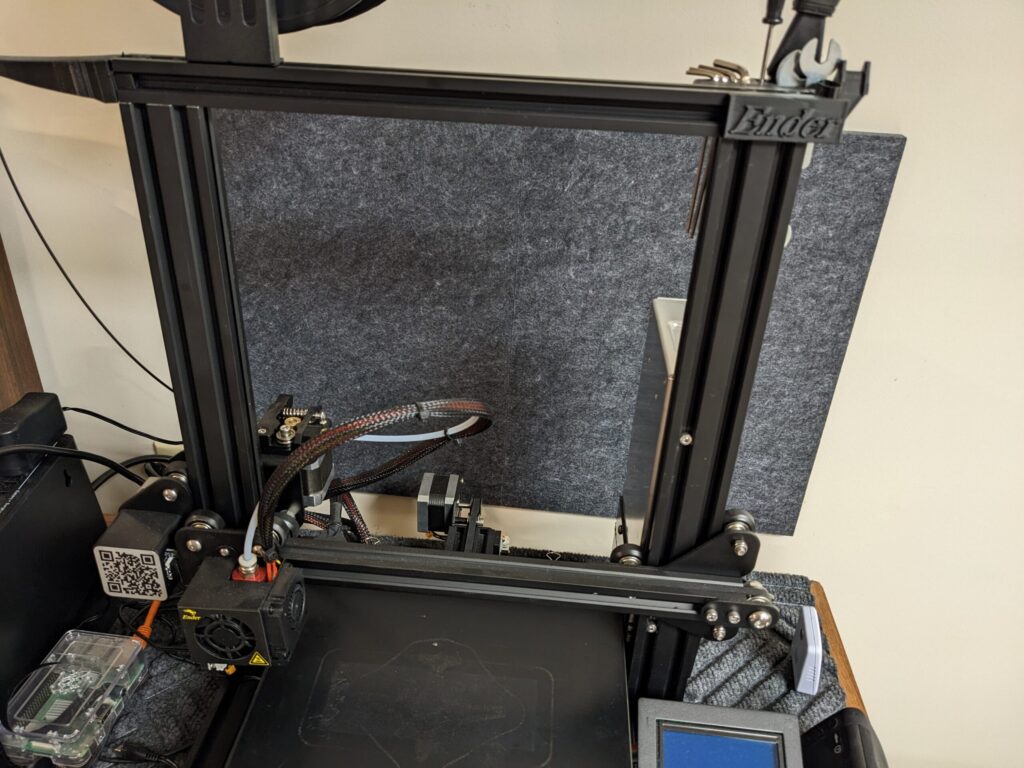
I thought the panels slightly reduced the sound reflecting back into the room. It wasn’t a dramatic difference, and I can’t entirely rule out that it was all in my head, but it seemed to change the way the noise reached me at my desk some fifteen feet away. Whatever the explanation, I thought it was an improvement.
The Sump Room Became Another Project
My basement sump room eventually became home to a small server and backup area. I needed space for a third R720 that I was going to use for the ESXi-to-Proxmox migration, and I didn’t want to disturb the existing server rack’s configuration.
The sump room seemed like a good option. It was a small space in a corner of the basement, although it had the same double bi-fold louvered doors as the furnace room. I didn’t see any reason to replace perfectly good doors just to reduce the noise from the server and desktops inside.
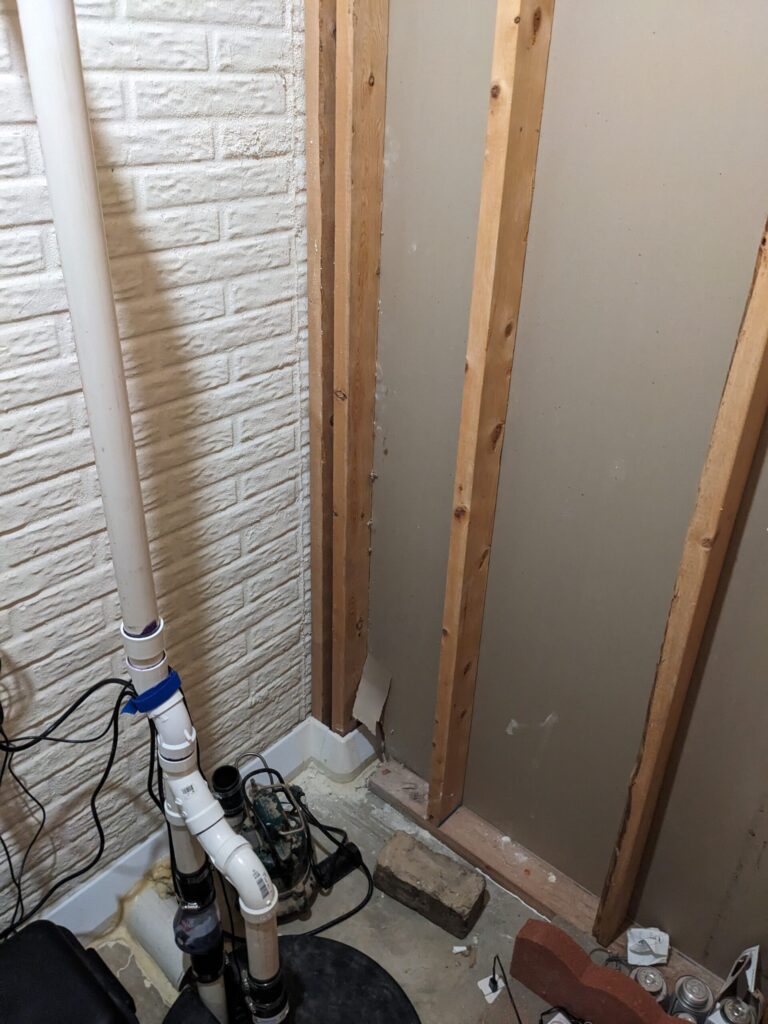
When I built that space, I installed three shelves for equipment, as well as a hanging rack for the server. One of the machines I put there was an i3 computer belonging to a friend, serving as his offsite backup target.
I put a mat down on the shelf beneath the desktop, but it was still a problem. The thing resonated through the shelf and into the wall, carrying the noise into the room. Sitting on the couch across the room, I could hear it plainly, especially during disk activity.
Very annoying.
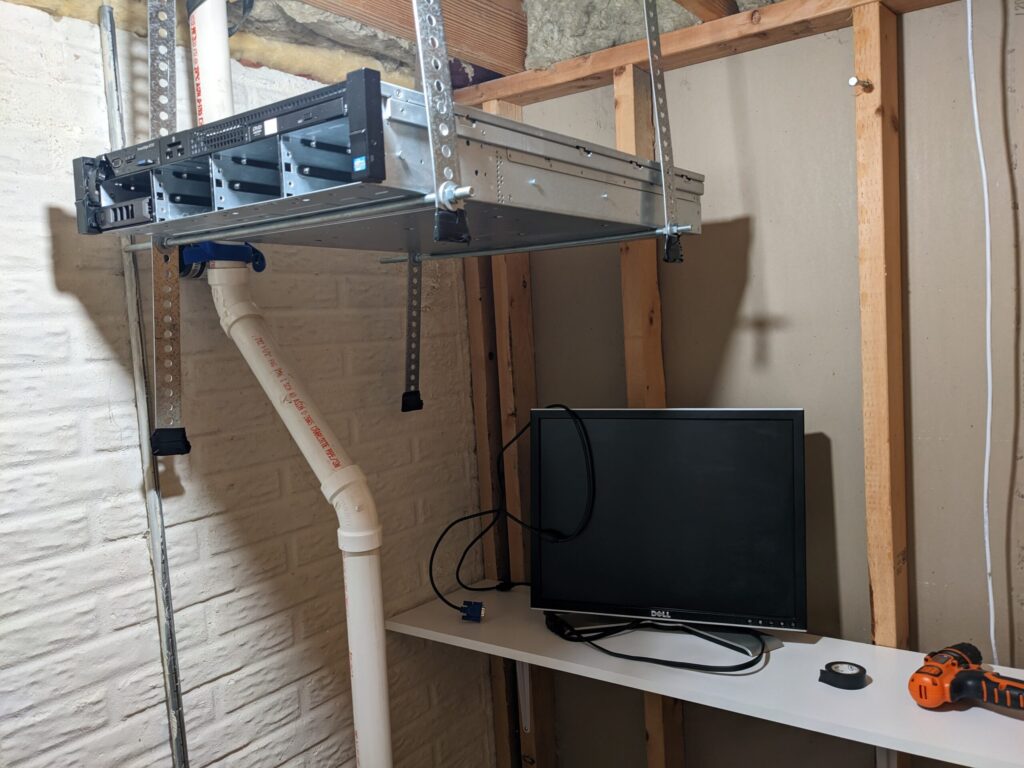
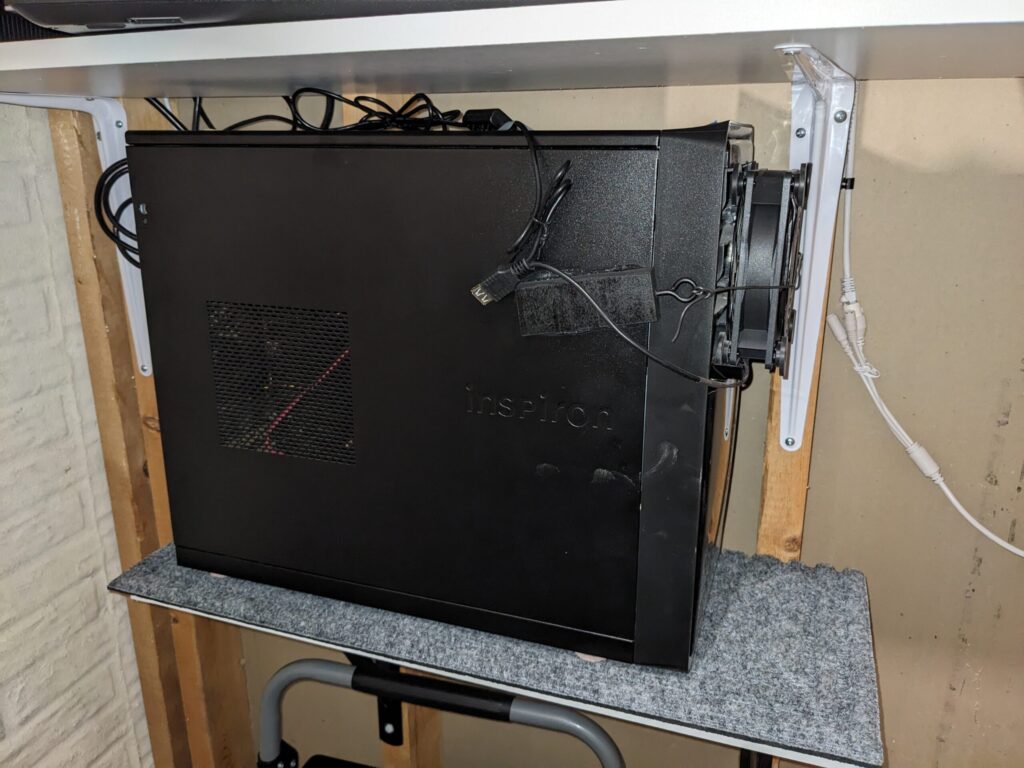
So I went back to Rockwool.
I filled the wall cavities with it, then covered the exposed insulation with white landscaping fabric. The fabric brightened the area somewhat and helped keep loose fibers out of the equipment space.
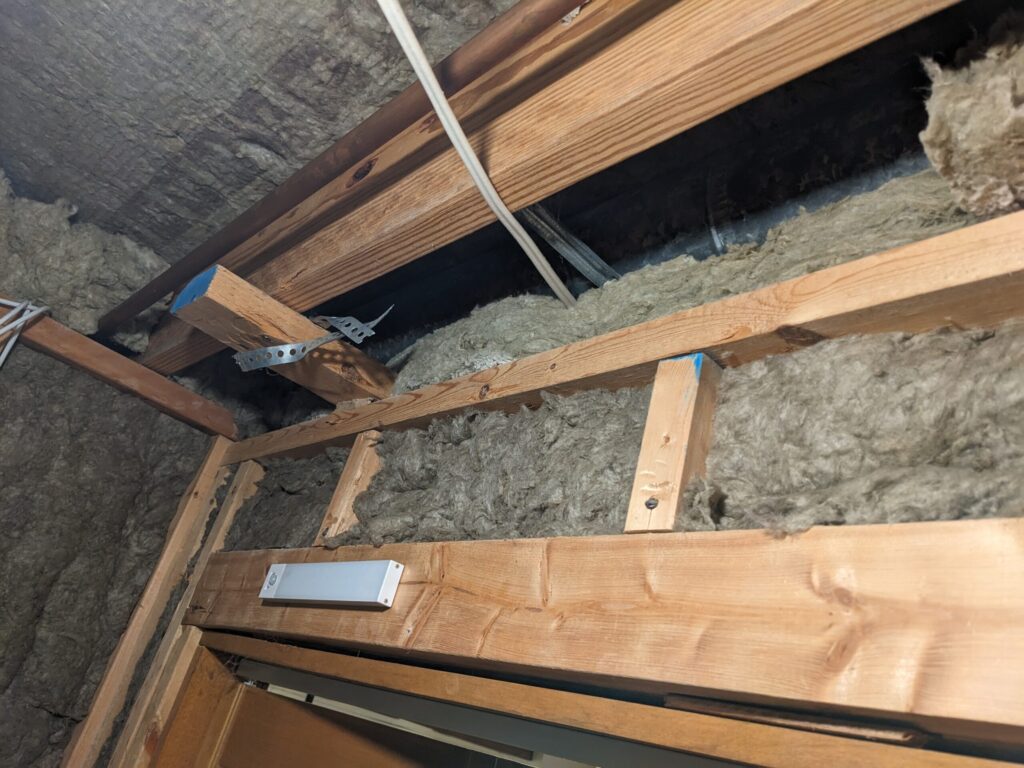
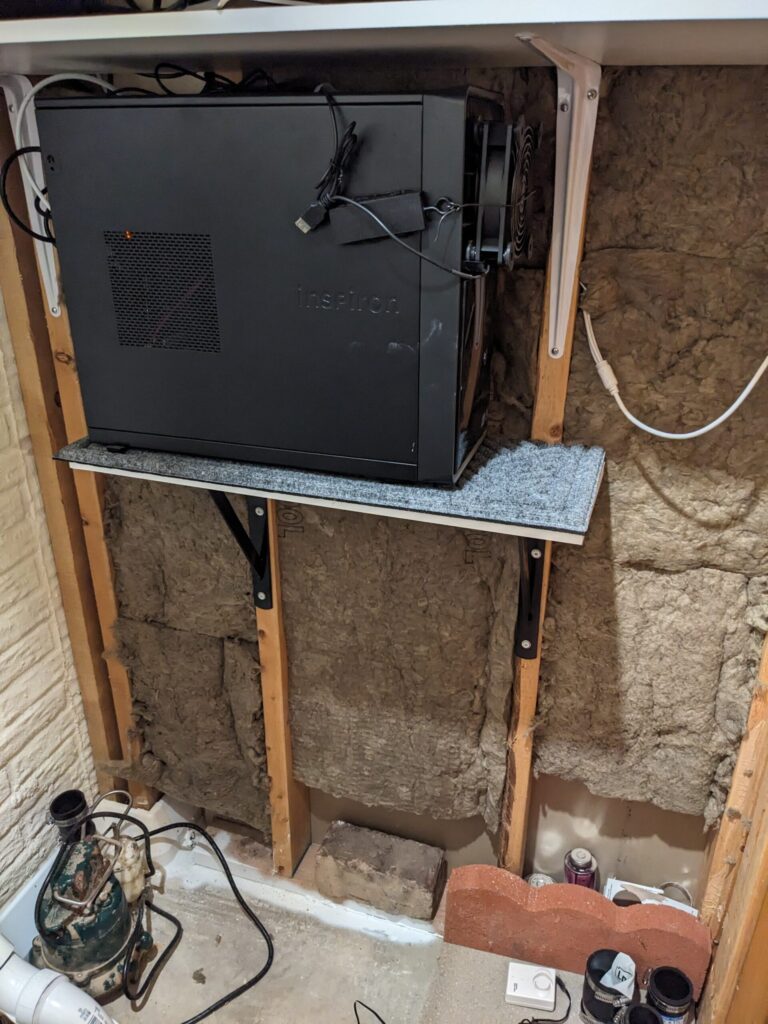
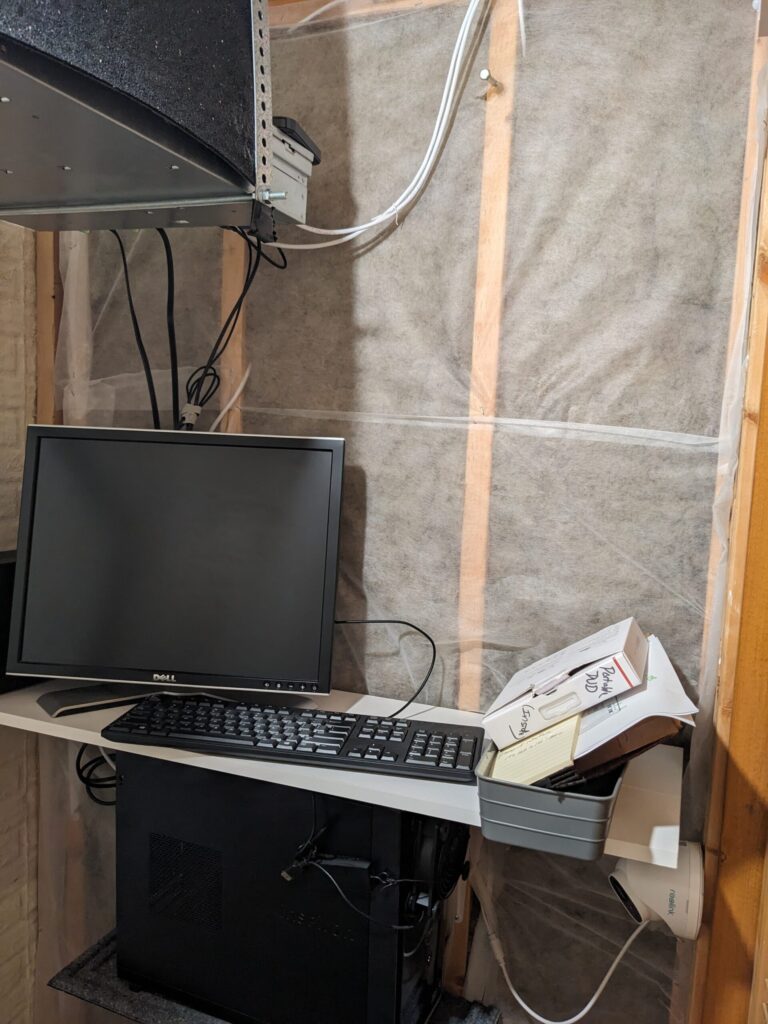
The white landscaping fabric wasn’t going to win any awards for appearance, but it covered the Rockwool nicely and brightened up the room. Besides, it was a basement equipment room. I wasn’t particularly concerned about how pretty it looked.
More importantly, the Rockwool made an immediately noticeable difference in how much equipment noise escaped the room.
The photographs show the progression pretty well, from the bare wall cavities to the installed Rockwool and then the white fabric covering everything.
I also experimented with acoustic panels and vibration isolation beneath other equipment in that room, including a Dell OptiPlex 7010, an external drive, and associated fans. Later, I added smaller pieces of carpet edging beneath the external drive enclosure.
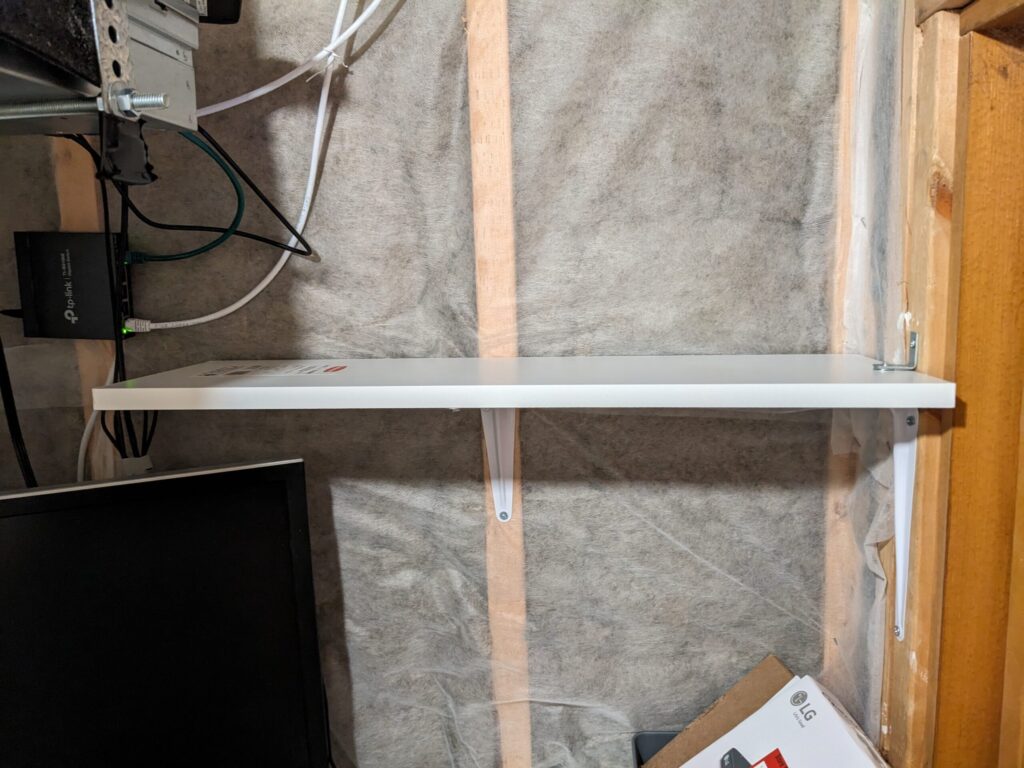
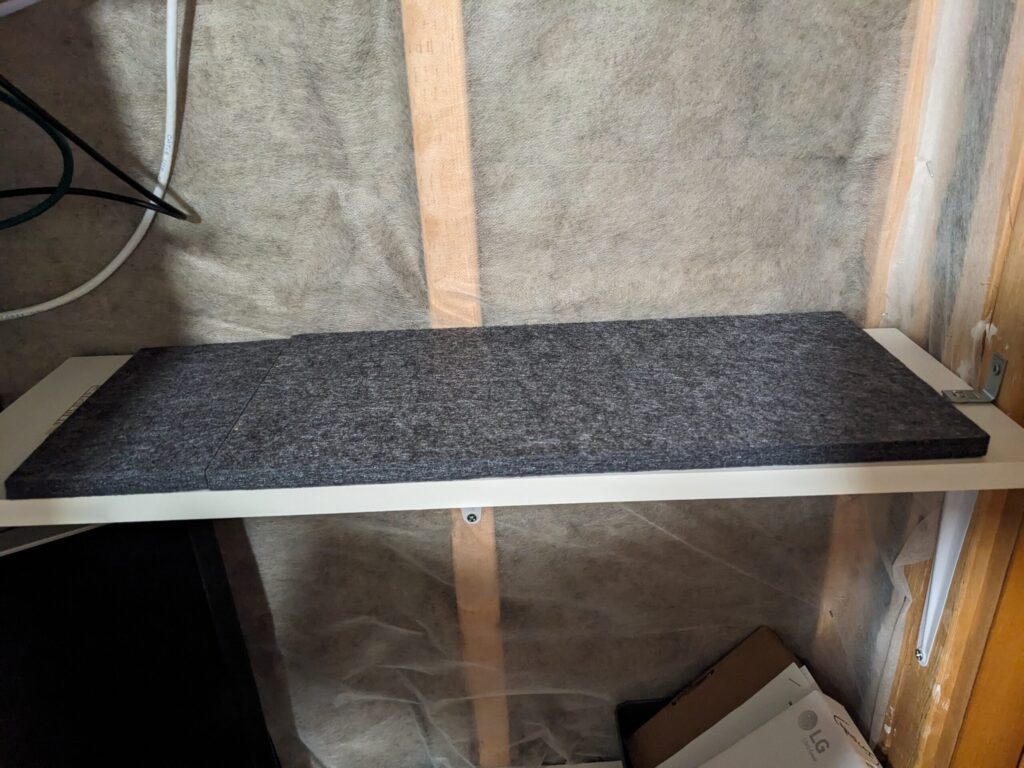
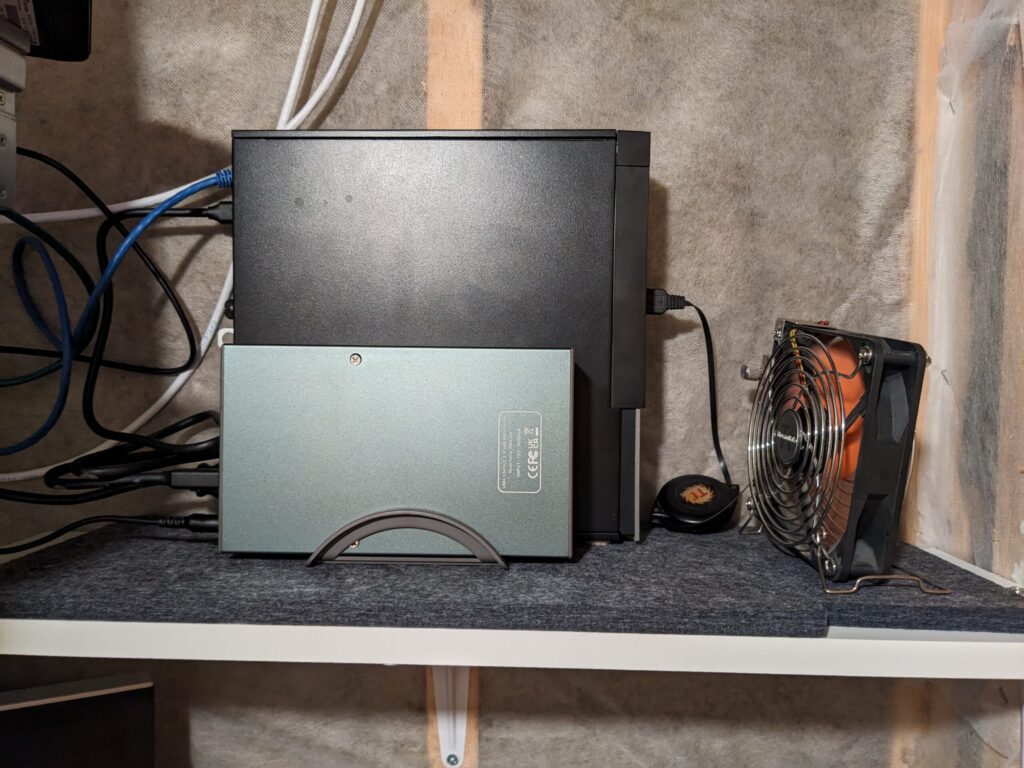
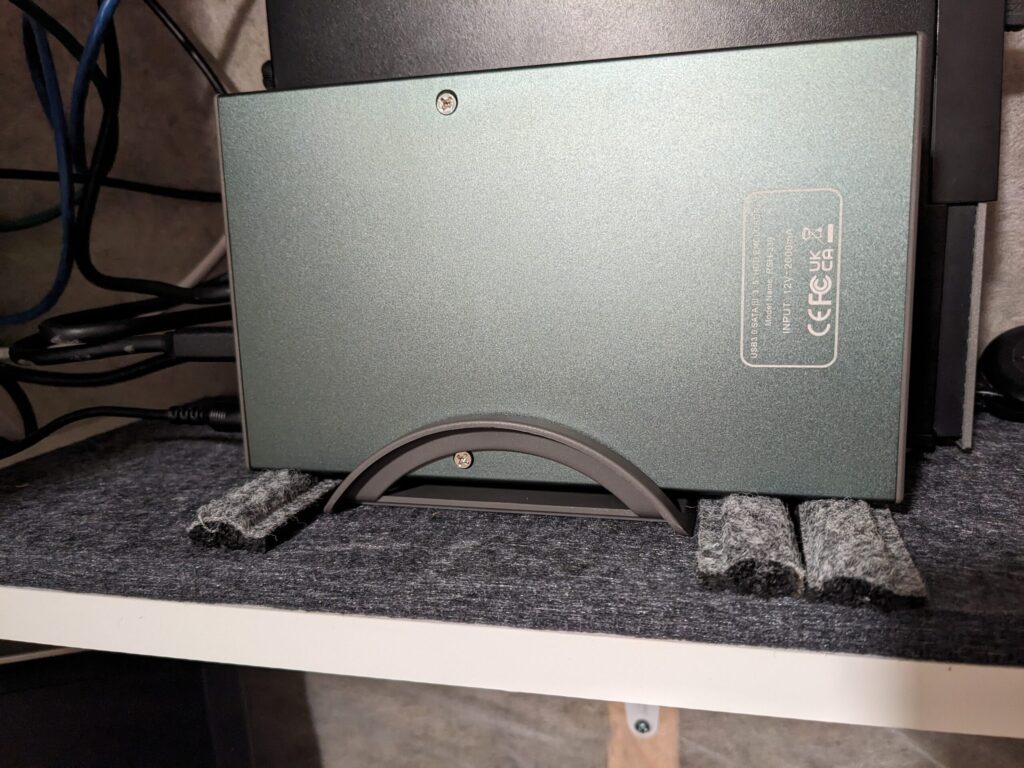
Nothing fancy. I already had the materials lying around, so I figured I’d try putting them beneath the equipment to keep some of the vibration from reaching the shelf.
And it worked.
By this point, I had accumulated quite a collection of materials for dealing with noisy equipment. And I was finding uses for practically all of them.
The Servers Weren’t the Only Things Vibrating
Eventually, I started applying the same ideas elsewhere in the house.
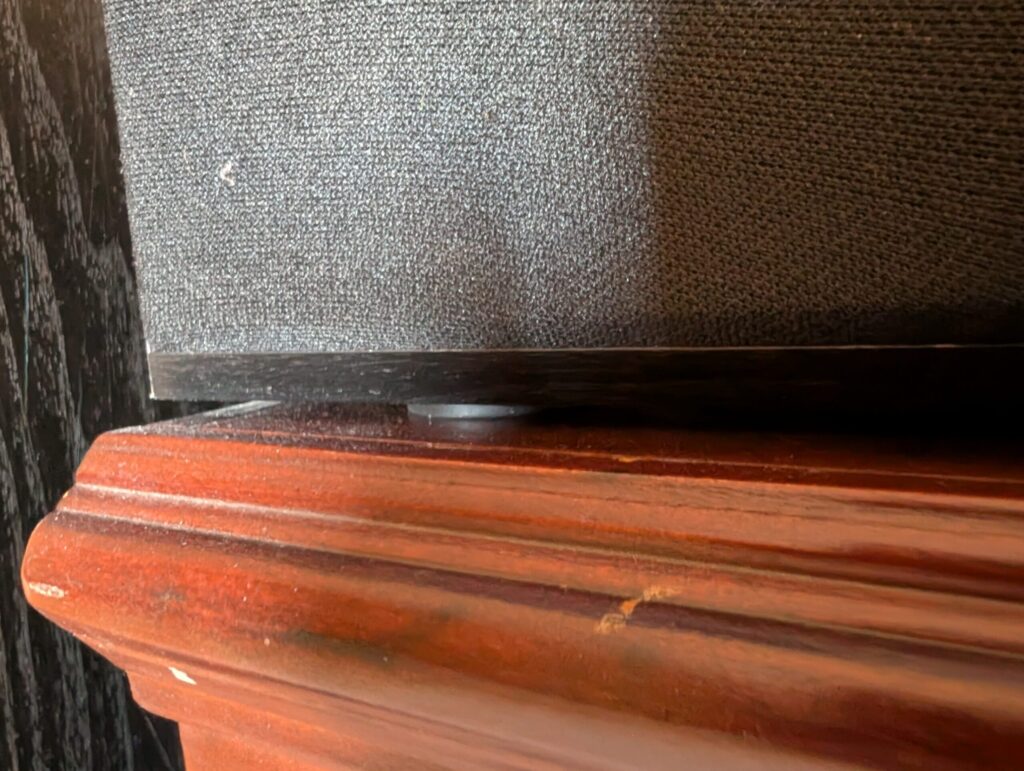
Our main television viewing area sits above a crawlspace. During bass-heavy movie scenes, the tower speakers could produce rumbling that traveled through the floor, into the crawlspace and basement. I (finally) installed isolation feet beneath the tower speakers. That more or less eliminated the rumbling I had been noticing in the basement when others were watching movies.
I also added isolation pads beneath the center-channel speaker, for good measure.
On either side of my basement workspace are two small Edifier speakers mounted to the wall, angled toward where I sit. The brackets grip the speakers from the sides, and I found that the contact between the speakers and the mounts could produce resonance. Adding a small strip of rubber between the speakers and the brackets took care of that.
And then there was the clothes dryer.
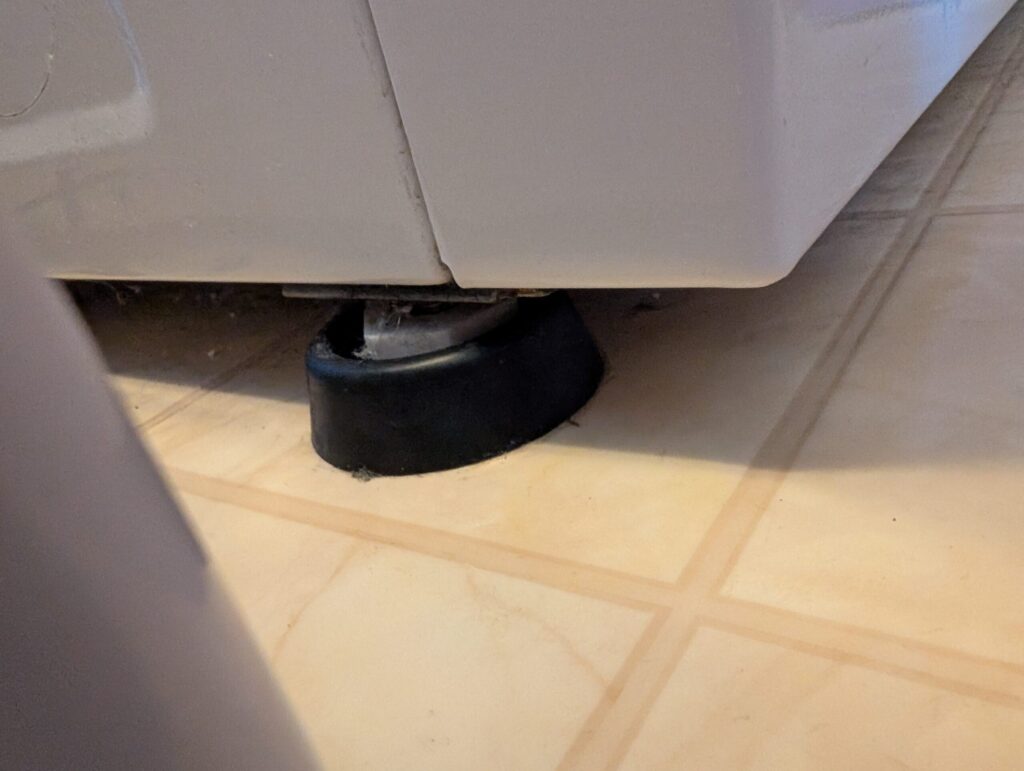
It’s located above the furnace room and basement, and its vibration could sometimes be heard downstairs. I added isolation feet beneath it, which helped reduce the noise transfer.
None of these projects required tearing apart a room or making major changes. Most involved trying something simple to keep vibrations from traveling through floors, shelves, or whatever else the equipment happened to be sitting on.
Sometimes the solution really was just putting a little rubber between two things that shouldn’t have been vibrating together.
Apparently, I Started Something
Over the years, some friends have heard about my experiences with Rockwool and decided to try it in their own homes.
One friend had a heat pump in the attic above his son’s bedroom. His son was a light sleeper, and whenever the heat pump started, it would wake him. After hearing about my experiences, they installed two layers of Rockwool in the attic above the bedroom.
Afterward, they couldn’t hear the heat pump starting.
Another friend had Rockwool installed in a wall during a bathroom remodel. The bathroom shared a wall with the dining room, and sound had been traveling between the two rooms. Adding Rockwool greatly reduced the noise transfer. It didn’t eliminate everything, but the improvement was substantial.
That project also produced an unexpected test of the insulation’s water resistance. The contractor made a mistake with the plumbing, and a leak developed inside the wall. After the leak was repaired and everything had been properly dried, the existing Rockwool was able to remain in place.
Rockwool mineral wool is water-repellent and noncombustible, but that doesn’t mean you can ignore a leak inside a wall. The surrounding materials still need to be checked and properly dried.
Fortunately, in this case, the insulation didn’t need to be replaced.
It’s been interesting to see the same material used successfully in such different situations: a furnace room, basement ceilings, an attic bedroom, a server room, and a bathroom wall.
What I’ve Learned After Nearly Ten Years
If there’s one lesson from all these projects, it’s that there isn’t a magic product that makes every noise disappear. Different problems require different solutions. When I could reduce the noise at its source, as with the server fans, that often made the biggest difference.
When vibration was traveling through shelves, floors, or mounting brackets, isolation materials helped.
When sound was reflecting off nearby surfaces, acoustic panels could help.
And when I wanted to reduce sound traveling between rooms or floors, Rockwool became my preferred material, often combined with sealing gaps where sound could bypass the insulation.
If I’ve learned anything from all this, it’s that combining different materials usually worked better than relying on just one. I also learned that making one thing quieter tends to reveal the next thing that’s been annoying you all along.
First the furnace. Then the keyboard upstairs. Then the servers. Then the refrigerators. Then something vibrating on a shelf.
And lately, I’ve even started noticing the ticking of wall clocks.
Yes, I’ve now replaced several perfectly functional wall clocks with silent versions because I could hear them ticking. I know– I am not right in the head.
After all the Rockwool, MDF, rugs, rubber feet, and acoustic panels, that particular solution was remarkably simple.
Buy quieter clocks.
There’s probably still something in the basement waiting for me to notice it. But it’s a much quieter place to work than it was when I started.
And that’s really all I was trying to accomplish.
Materials and Products I’ve Used
Over the years, I’ve experimented with quite a few materials to reduce noise and vibration around the house and my computing equipment.
Below are the ones mentioned in this article, along with links where I have them. These aren’t necessarily the best products available, and I’m certainly not suggesting everyone needs to buy all of them. They’re simply things I’ve used, sometimes in combinations that worked better than any one material by itself.
Insulation and Sound Absorption
- Rockwool mineral wool insulation — My favorite material for reducing noise traveling between rooms, through walls, and between floors. Used in my furnace room, sump room, basement ceiling joists, and rim-joist cavities.
- Acoustic panels — Used behind refrigerators, the freezer, my Dodeca, and other equipment to reduce reflected sound.
- Mohawk utility rug/mat — Cut into sections and used beneath appliances, on equipment shelves, and around servers.
- White landscaping fabric — Used to cover exposed Rockwool in the sump room, primarily to contain loose fibers and brighten the space.
Vibration Isolation
- Tower speaker isolation feet — Installed beneath my tower speakers to reduce bass-related vibration traveling into the floor and crawlspace.
- Isolation pads — Used beneath my center-channel speaker.
- Washing machine isolation feet — Used beneath my clothes dryer.
- Rubber isolation feet — Used beneath various pieces of equipment and as spacers between the network switches.
Other Materials and Equipment
- MDF boards — Used to add mass around the servers and as part of various layered sound-reduction arrangements. Pulled from my garage stockpile and cut to fit.
- AC Infinity cooling fans — Used in some of my equipment arrangements to maintain airflow. I used three different models, depending on the location. AC Infinity MULTIFAN S7, AC Infinity MULTIFAN S4, and AC Infinity MULTIFAN S3.
- Silent wall clocks — Replaced several ticking clocks after the house became quiet enough that I started noticing them. I purchased a couple options from Amazon but do not have enough history with them to make a buyer suggestion.
A few of these products may have changed or disappeared from retailers since I purchased them. Where possible, I’ve linked to the actual items I used rather than simply choosing something similar.
And one last reminder: when adding materials around servers, computers, appliances, or other equipment, don’t obstruct ventilation or interfere with their cooling requirements. A quieter piece of equipment isn’t much of an improvement if it overheats.
Leave a Reply